Role: Creative Strategy Lead / UX Design Lead
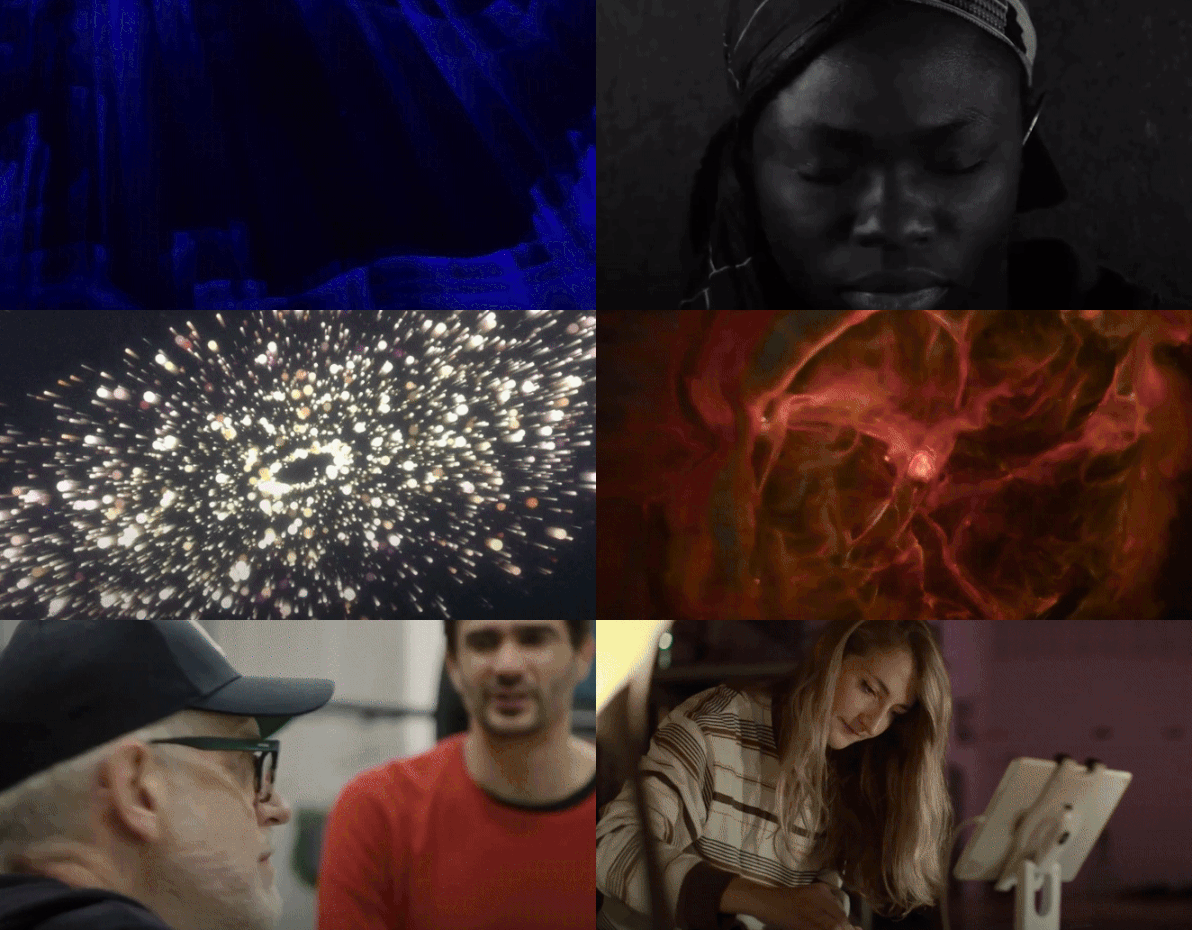
Part of UNBOXED 2022: Creativity in the UK festival, Dreamachine is a large scale installation created by Collective Act, in collaboration with Holition, Assemble Architects, Jon Hopkins, scientists Anil Seth, Fiona McPherson, and David Schwartzman, and a wider team of collaborators. The installation is a spatial adaptation of an experience based on a 1959 invention by artist–inventor Brion Gysin. The experience uses light to induce stroboscopic hallucinations, taking visitors on a magical journey to explore the extraordinary potential of the mind
DREAMACHINE is a large-scale installation by Collective Act exploring the subjectivity of perception through stroboscopic light. The installation is a spatial adaptation of Brion Gysin's 1959 invention. The work uses controlled visual stimulation - experienced with eyes closed - to induce hallucinations, investigating the extraordinary generative capacity and subjectivity of human perception. The work was created alongside neuroscientists Anil Seth, Fiona McPherson, and David Schwartzman, composer Jon Hopkins and Assemble Architects, the project positions itself between art, tech, neuroscience, and phenomenology.
My work (through my role at creative tech studio, Holition) focused on translating ineffable subjective experience into shareable narratives and tangible knowledge. In a post-experience Decompression Space, I designed interactive tools allowing visitors to articulate their visual, sonic, cognitive, and physical sensations, confronting the fundamental challenge of representing each individual's subjective consciousness through structured interfaces. A digital experience served to guide visitors through a reflection/examination of their experience, to help them externalise what they experienced in their hallucinatory state.
The intent was to keep them in their minds for as long as possible, investigating visual, sonic, and chromatic qualities of the hallucinations, before moving them towards questioning their physical, sensory experience, and ending in a series of questions designed to engage them in a critical conversation of how perception is formed, how it varies, and what it means.
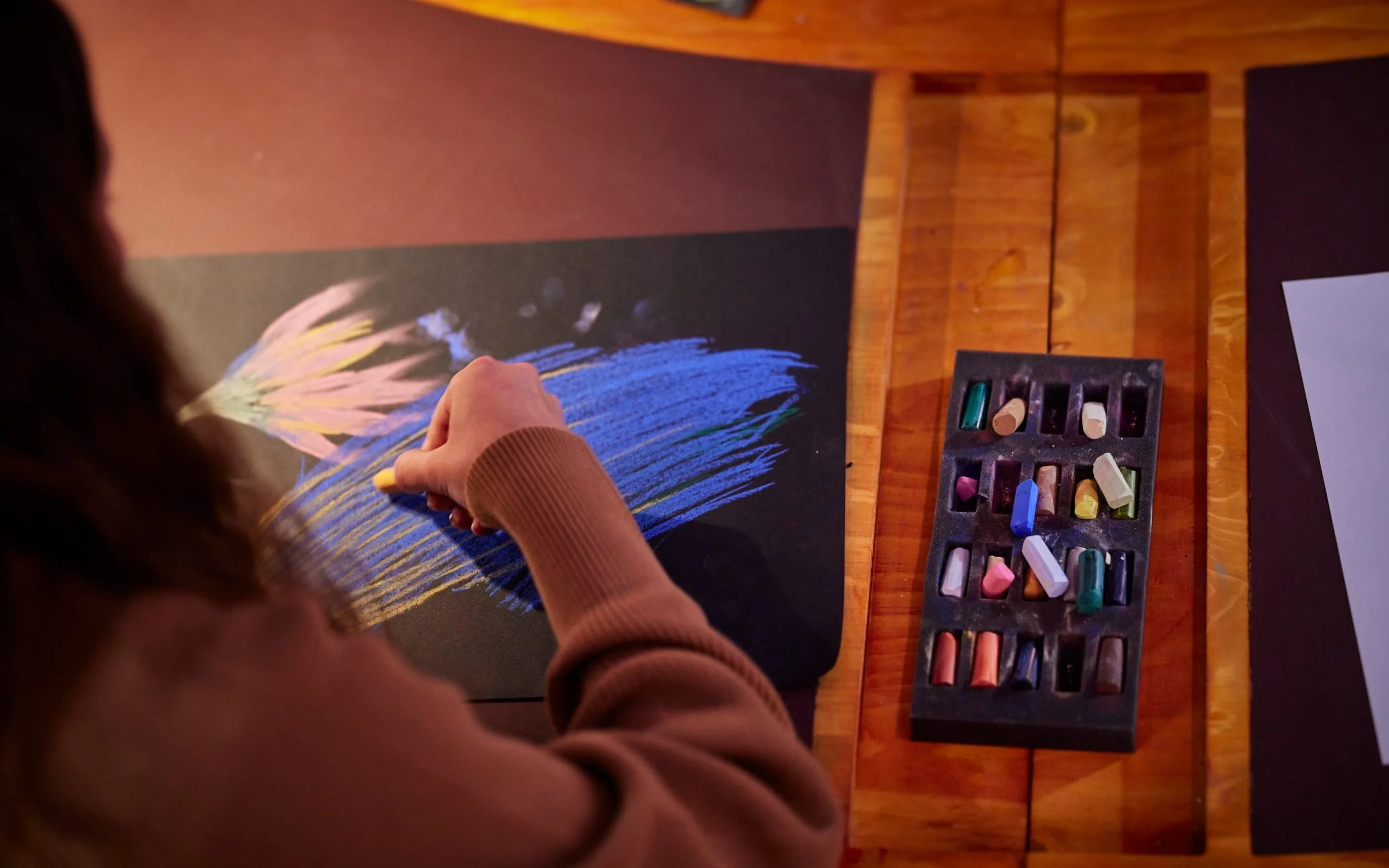
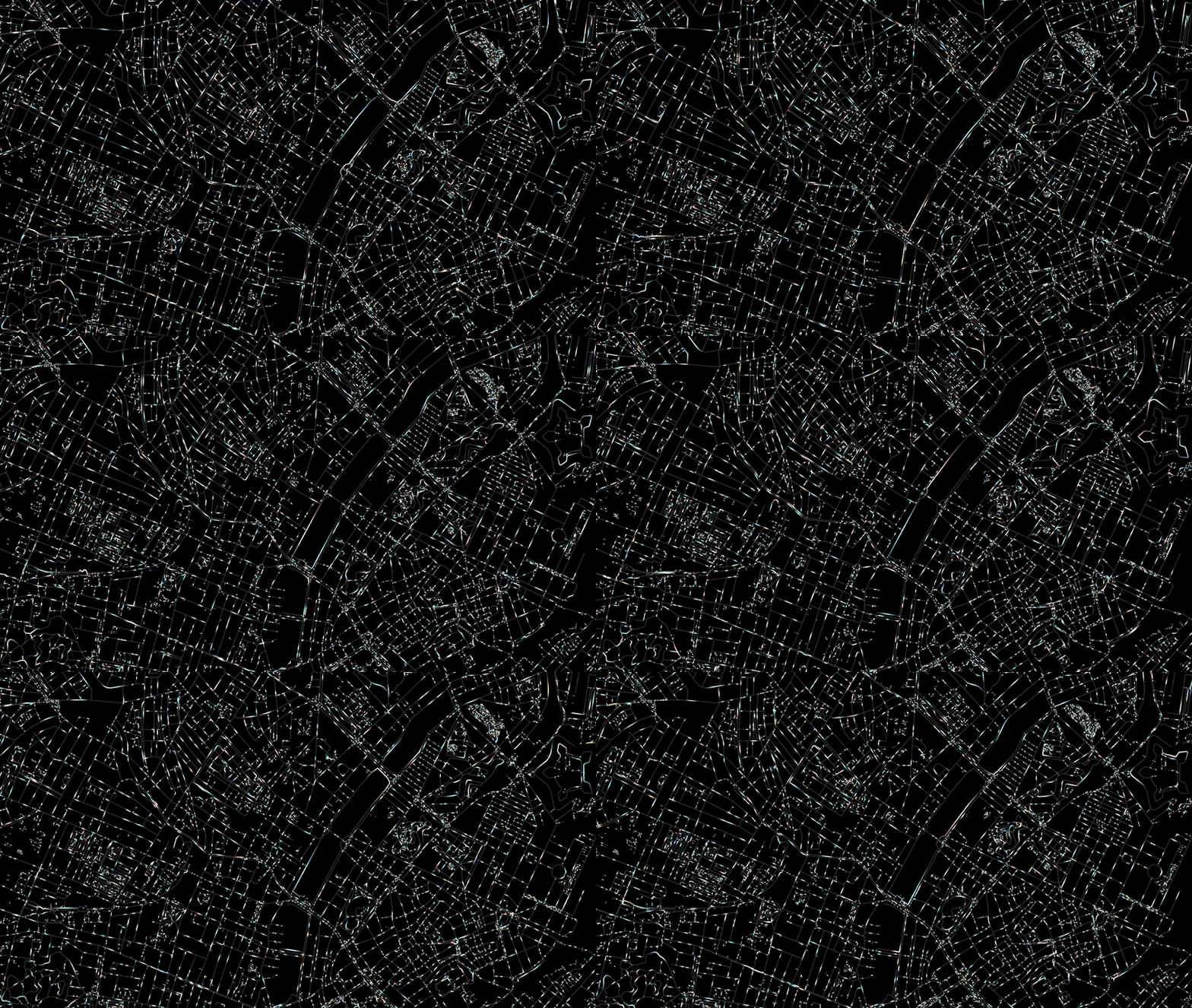
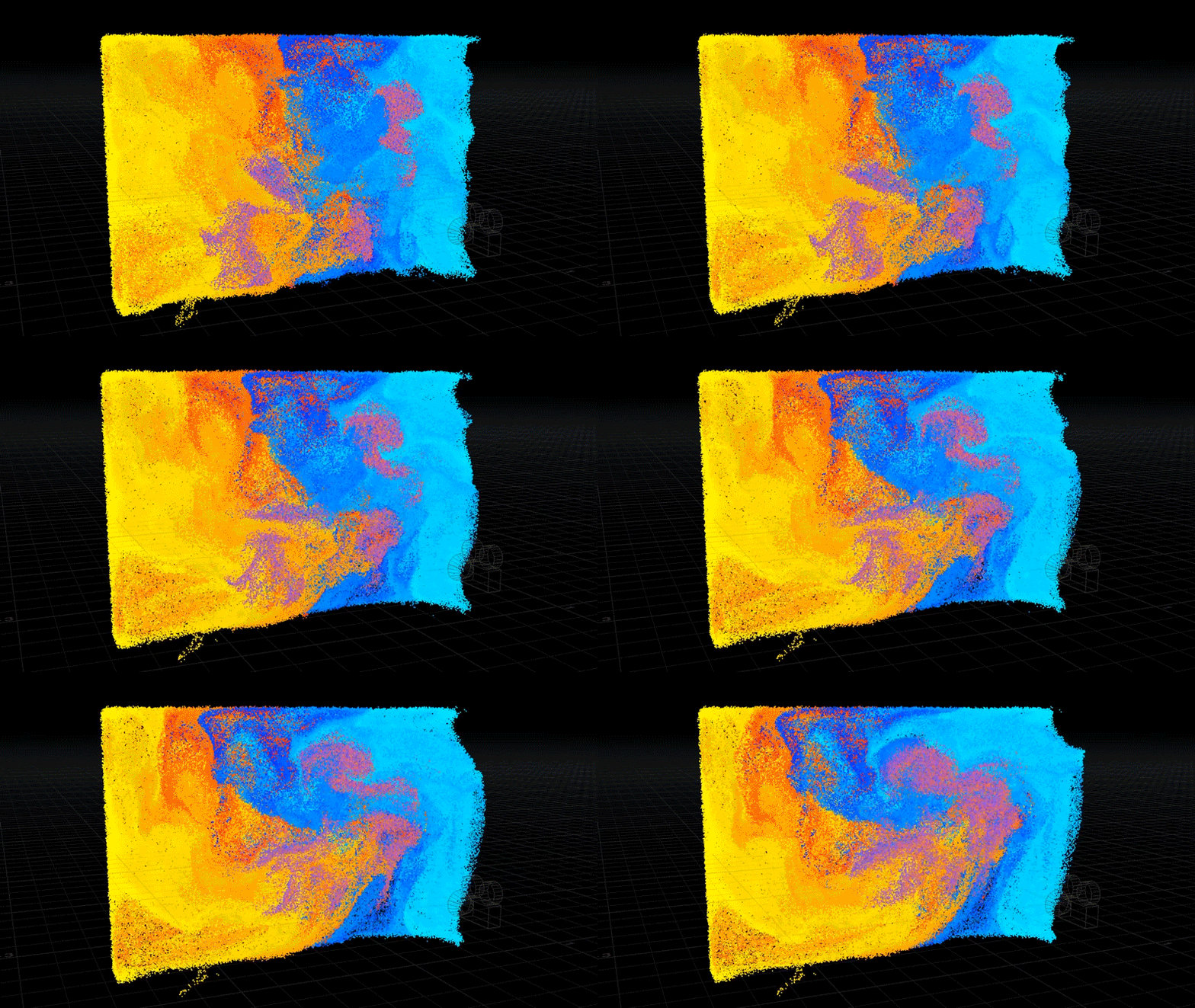
In another part of the Decompression Space, visitor data fed three live visualisations through an analog drawing station, creating a collective portrait of perceptual diversity. Drawings were scanned and integrated into the communal data visualisations and an online gallery, transforming individual hallucinations into shared cultural artefacts.
I also designed UX for The Perception Census alongside colleagues and neuroscientist Anil Seth. The census was amongst the largest studies of perceptual diversity ever conducted, and an attempt to map inner diversity, allowing participants explore how their sensory experiences diverge from others through a series of exercises and questions.
The design process for DREAMACHINE's experience sought to resolve questions about how we design systems that honour subjective experience while generating collective knowledge, and how to surface perceptual diversity to challenge assumptions about shared reality.
Photography: David Levene & Urszula Soltys
Role: Lead Strategist / Lead Experience Designer - Design Researcher in collaboration with Francis Norris
A consultancy project for Mercedes-Benz (Daimler AG) around the future of luxury. The work was divided into three phases exploring and identifying the current macro and micro-trends shaping luxury industries, a foresight phase projecting relevant trends into the future, and a creative conceptualisation and narrative design phase preceding the production of 3 concept films depicting possible future luxury automotive experiences.
This page will be updated in accordance with client permissions.
Role: Experience Designer
In Spring 2021, conceptual artist Jenny Holzer and the Guggenheim Museum Bilbao collaborated with Holition to showcase Holzer’s signature text-based art, now reimagined through the medium of augmented reality technology.
Technology in the service of art:
Made exclusively for the Guggenheim Museum Bilbao’s collection, we created a standalone mobile application which uses immersive technologies to deliver three distinct AR experiences.
LIKE BEAUTY IN FLAMES features texts by other authors selected by Holzer, including the app’s title, which is borrowed from Polish poet Anna Świrszczyńska’s poem “Beauty Dies.”
LIKE BEAUTY IN FLAMES is a continuation of what Holzer does best: placing thought-provoking texts in the public sphere in a democratic and accessible way.
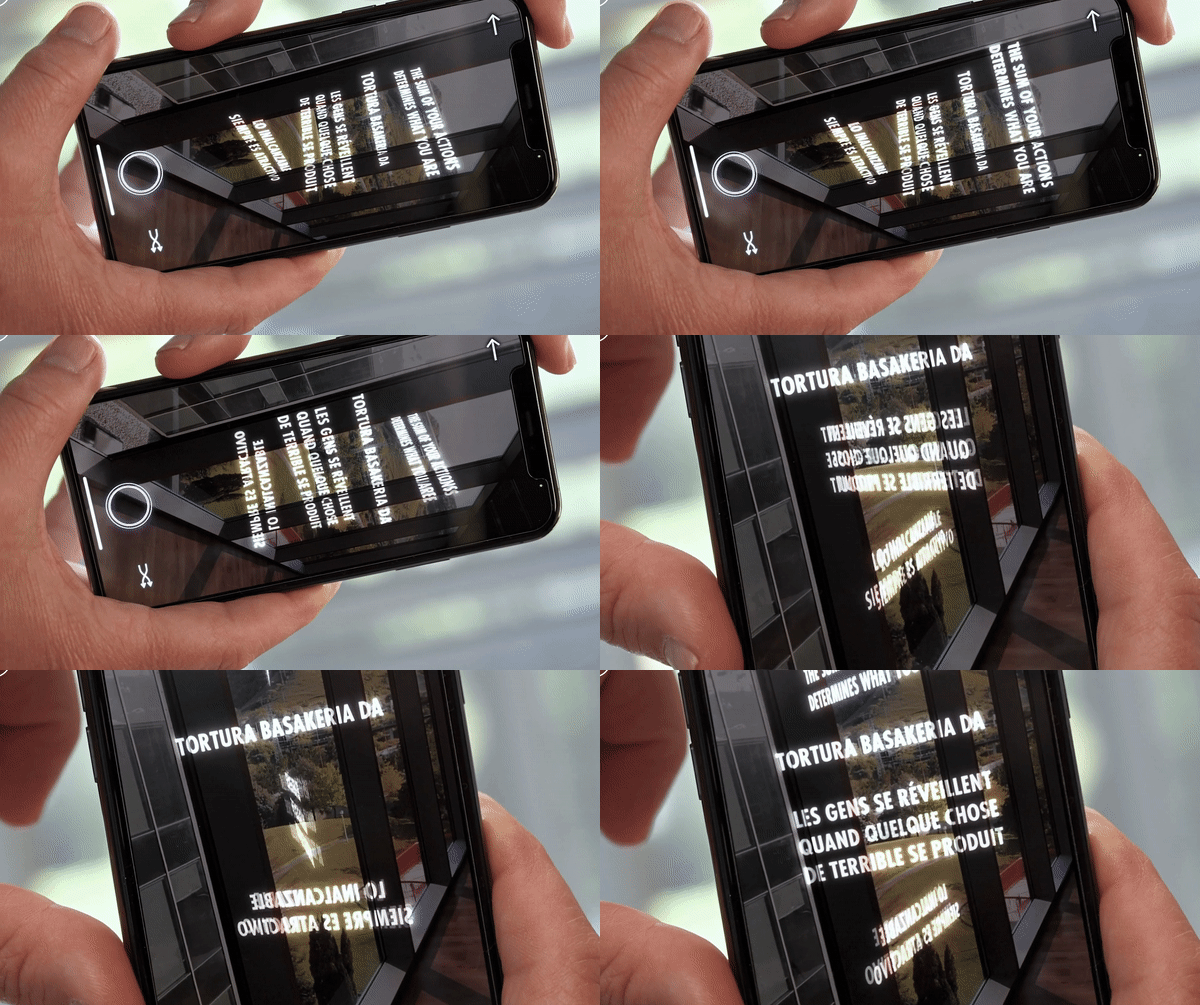
Inside the Guggenheim Bilbao, an AR version of one of Holzer’s signature LED signs glides through the museum’s central atrium, the column bending and spiralling as truisms in English, Spanish, Basque, and French scroll past. Each of the museum’s three floors provides a different experience, as the LED’s interaction with the building’s architecture shifts depending on one’s vantage point.
Outside, AR projections appear on the museum’s facade from five locations around the campus in a virtual echo of the artist’s monumental 2019 work for Bilbao.
The third AR experience gives app users unrestricted access to Jenny’s work from anywhere in the world, beautifully encapsulating her mastery of placing language in unexpected spaces to spark reflection and contemplation.
Insight - Reimagining the future of art
Harnessing augmented reality, advanced image recognition technology, 3D spatial positioning and cutting-edge graphics features, users are able to see the AR version of the LED sign move through the museum’s atrium.
They can also see a recreation of Holzer’s nighttime projections, facilitated by their mobile devices’ GPS and gyroscope features, which direct them to various points around the outside of the museum.
Combining digital technologies with the real world, this innovative mobile app developed by Holition brings Holzer’s practice directly to users’ own mobile devices.
Photo credits (in order):
Photo: Erika Ede. LIKE BEAUTY IN FLAMES, 2021
Text: “A Soldier Says” from Building the Barricade by Anna Świrszczyńska, English translation by Piotr Florczyk, © 2016 by the translator. Used with permission of Ludmiła Adamska-Orłowska and the translator; “Galdeketa” from Azalaren kodea by Miren Agur Meabe, © 2000 by the author. Used with permission of the author; “Marca de nacimiento” from Santo y seña by Pura López Colomé, © 2007 by the author. Used with permission of the author.
Guggenheim Bilbao Museoa, Spain
© 2021 Jenny Holzer, member Artists Rights Society (ARS), NY
Photo: Erika Ede
LIKE BEAUTY IN FLAMES, 2021
Augmented Reality app
Text: Truisms, 1977–79
Guggenheim Museum, Bilbao, Spain
© 2021 Jenny Holzer, member Artists Rights Society (ARS), NY
Video courtesy of Guggenheim Museum Bilbao
Role: Creative concept designer - Creative strategist.
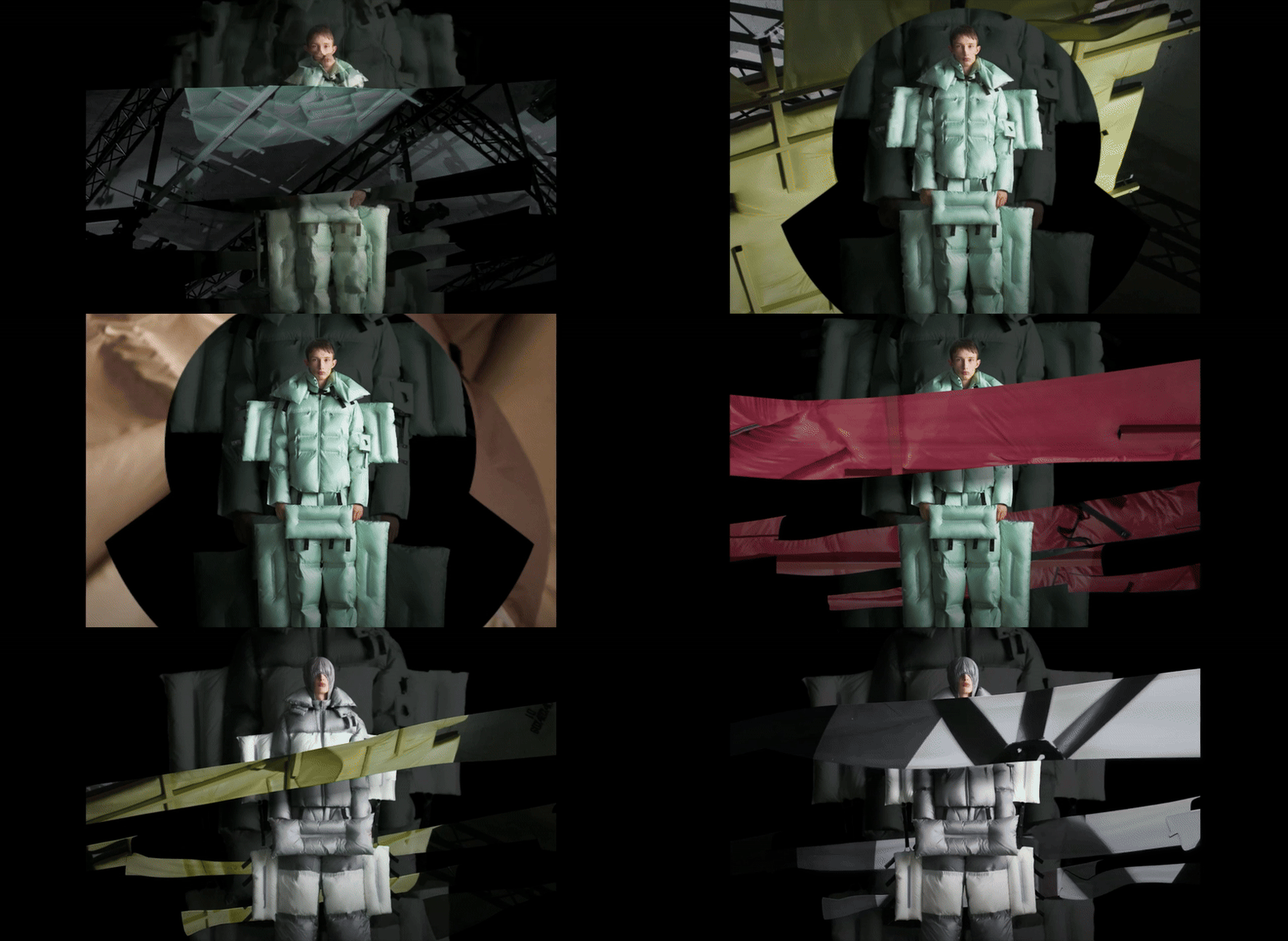
Creative concept and strategy for Moncler Genius’s House of Genius pop ups. The brief entailed creating 3 different experiences in the same space for the pop-ups, all of which could house a rotation of 27 different collections, each also with its own narrative. The challenge was to come up with 3 main narratives that could function on their own, but also be able to hold that extra temporary layer of narrative without being compromised. The brand’s tagline, ‘one house, different voices’ meant that we needed to truly think of what polyphonic means, and how it could manifest into an experience. The brand’s concept was that different creative directors would interpret Moncler’s basic down jacket into a collection of their own, each of them naturally drawing in their own audience based on the story they would choose to tell through their collection. Naturally, the 3 narrative spaces ended up being a breakdown of that, starting with a space that told the story of the materiality, moving onto an experience that showed the designer’s process, and ending with the world that each designer had built through their interpretation. The materiality experience was a proposal for a mechanical wall made out of the basic material used to make the jacket, which would morph and shape itself to mirror the silhouette of the person standing in front of it, reflecting the essence of the brand, and how focused it is on its audience. The second experience, being the Design Process room, saw a sculptural piece of fabric suspended in the space, with a projection mapping of behind-the-scenes footage of the creation of each collection. The third and final space was covered in screens on all surfaces, and involved a mechanism where as soon as a visitor picked up a garment, they would trigger visuals from that collection’s world, immersing themselves, and anyone around them in it. The pop up ran in Milan, Tokyo and Paris simultaneously. When we went into production, some constraints meant that the first room’s implementation had to be altered, but the narrative still worked.
Sketches by Marinus Maier. Photo credits: Moncler
Role: Lead UX Design, UI Design (in collaboration with Digital Designer/Animator Alina Arefyeva)
A NEW KIND OF MARKETSPACE
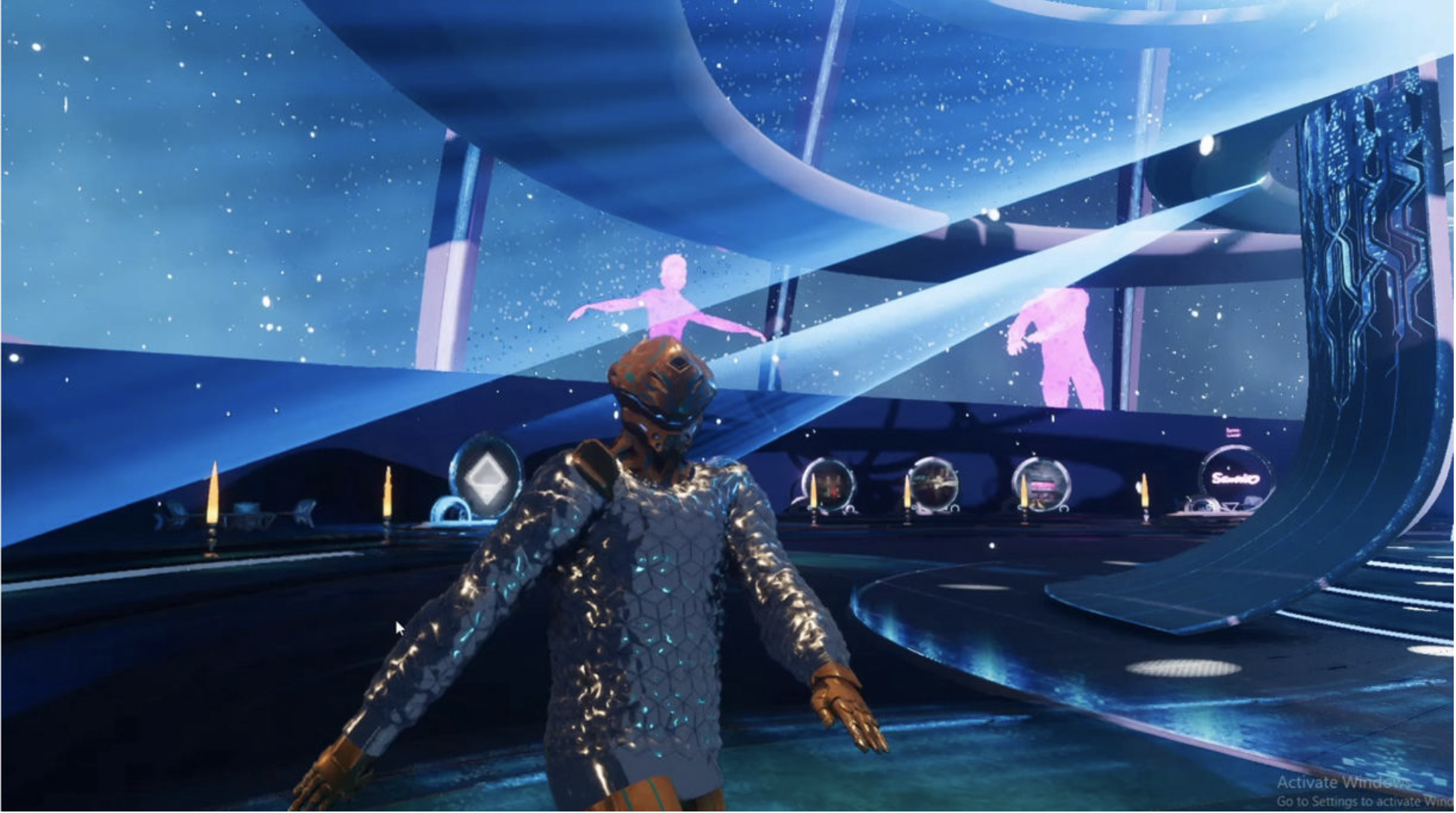
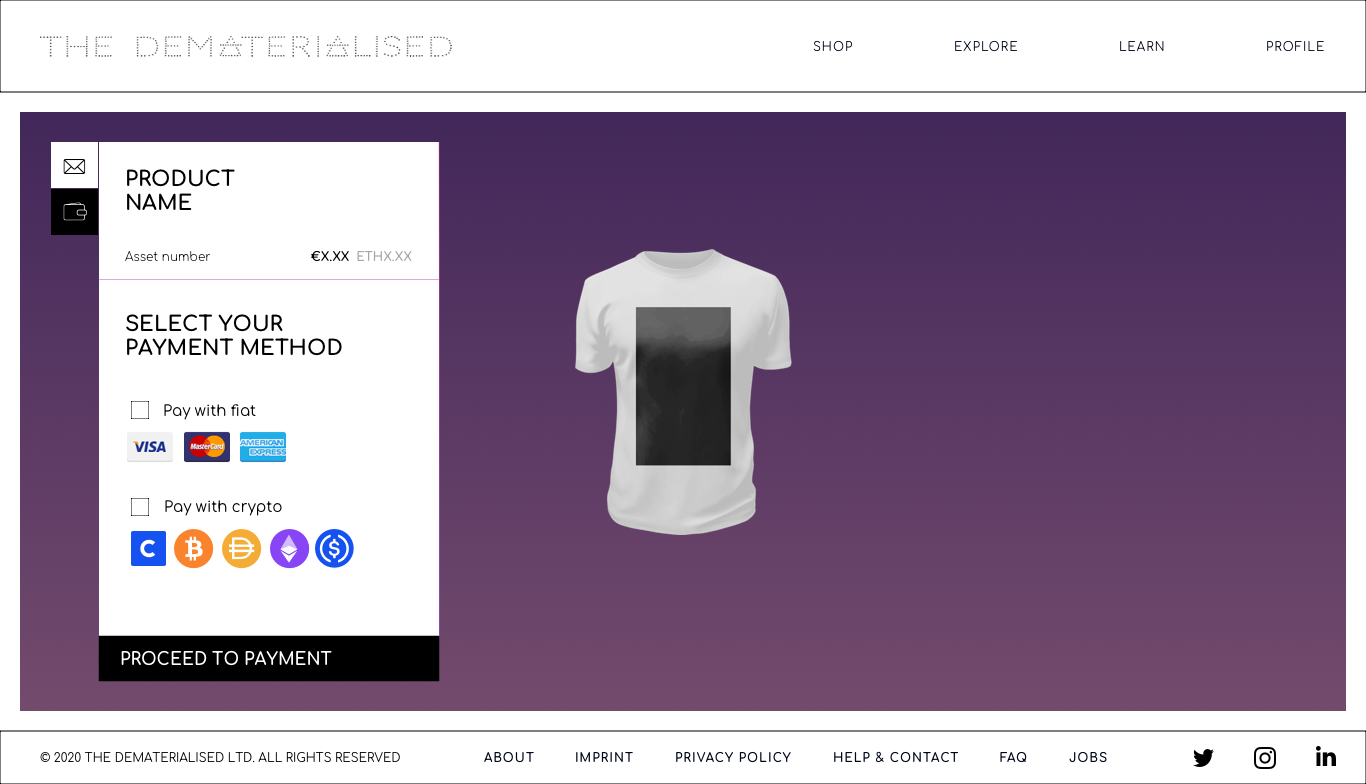
The Dematerialised approached Holition to design their digital fashion platform, where users can try on and purchase pieces from the most prominent designers. Since this is a relatively new market, it was extremely important to design an experience that was intuitive, clear and educational, but not information heavy. Users had to be presented with concise but important information through the relatively straightforward product discovery and purchase process. One of the objectives was to make this feel like a physical store that had just migrated online, so the users could feel like they’re able to ‘walk around’ and stumble upon different experiences in the virtual space, much like they would in a brick and mortar store. As users landed on the site, they were encouraged to enter this virtual store, and while moving through it, were able to discover experiences that range from try-on and product displays that they could view in 360, to loot boxes that they could purchase.
________________________________________________________
The visuals were designed to mimic the visual language of clothing tags, with the use of icons and a clear black and white colour scheme, appearing as pop-ups on top of the 3D environments. Designing this project involved multiple rounds of user testing in order to fine-tune the journey, and make sure the new industry terminology, product use cases and payment process were super clear. Testing sessions were conducted with users who were accustomed to making purchases using crypto and fiat currencies, and who had varying knowledge of purchasing digital goods.
________________________________________________________
Aside from providing the users with product information, it was important to educate them about the use cases of a digital garment, enabling them to see the value in purchasing one. As the user progressed through the product page, they were able to learn more about its design and creation, as well as what they can do with it. That was reiterated as a reminder after purchase, with links to perform actions related to each use case.
Role:
Narrative/UX Design Lead
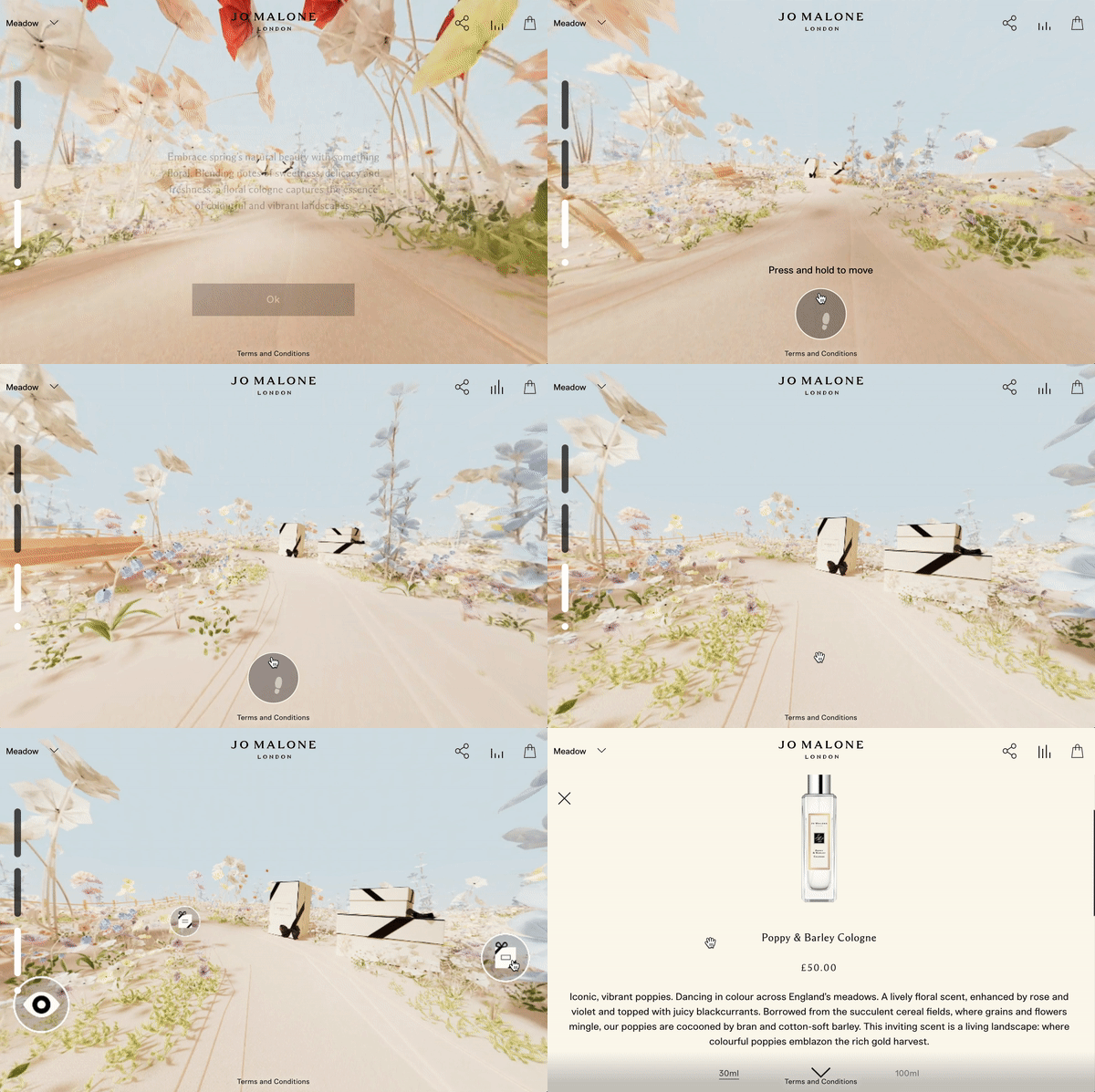
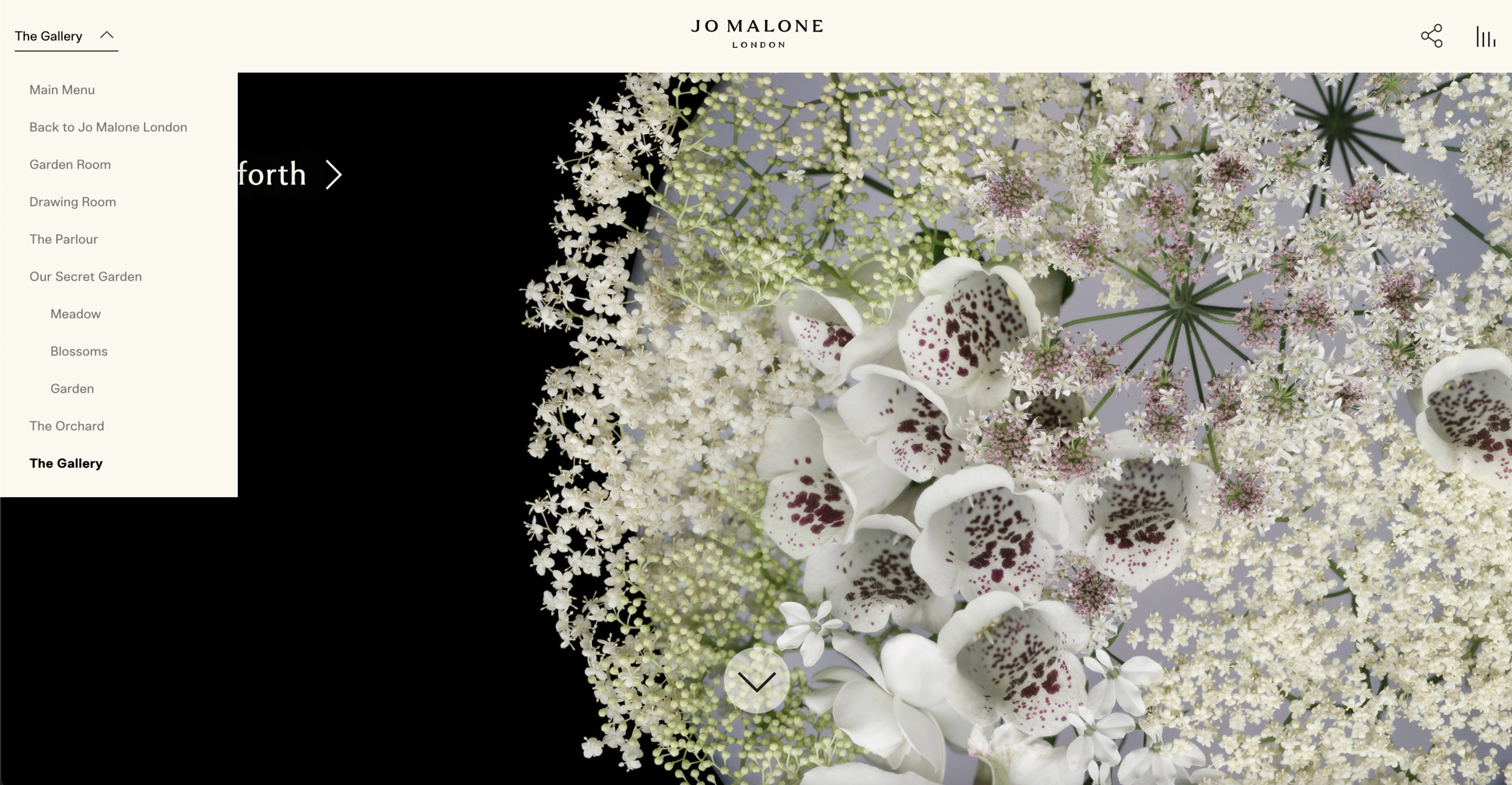
At the beginning of 2020, my team at Holition needed to create strategies for clients to survive - and thrive - through the sudden shift from physical retail, to purely digital. One such strategy was designed for British luxury fragrance brand - Jo Malone. The experience took on a narrative approach to the retail journey, breaking away from the constructs of traditional retail journeys, and enabling users to engage in a self-guided discovery process, driven by their curiosity to explore.
The experience unfolded as an invitation to enter a world of enchantment inside the Jo Malone Virtual Townhouse.
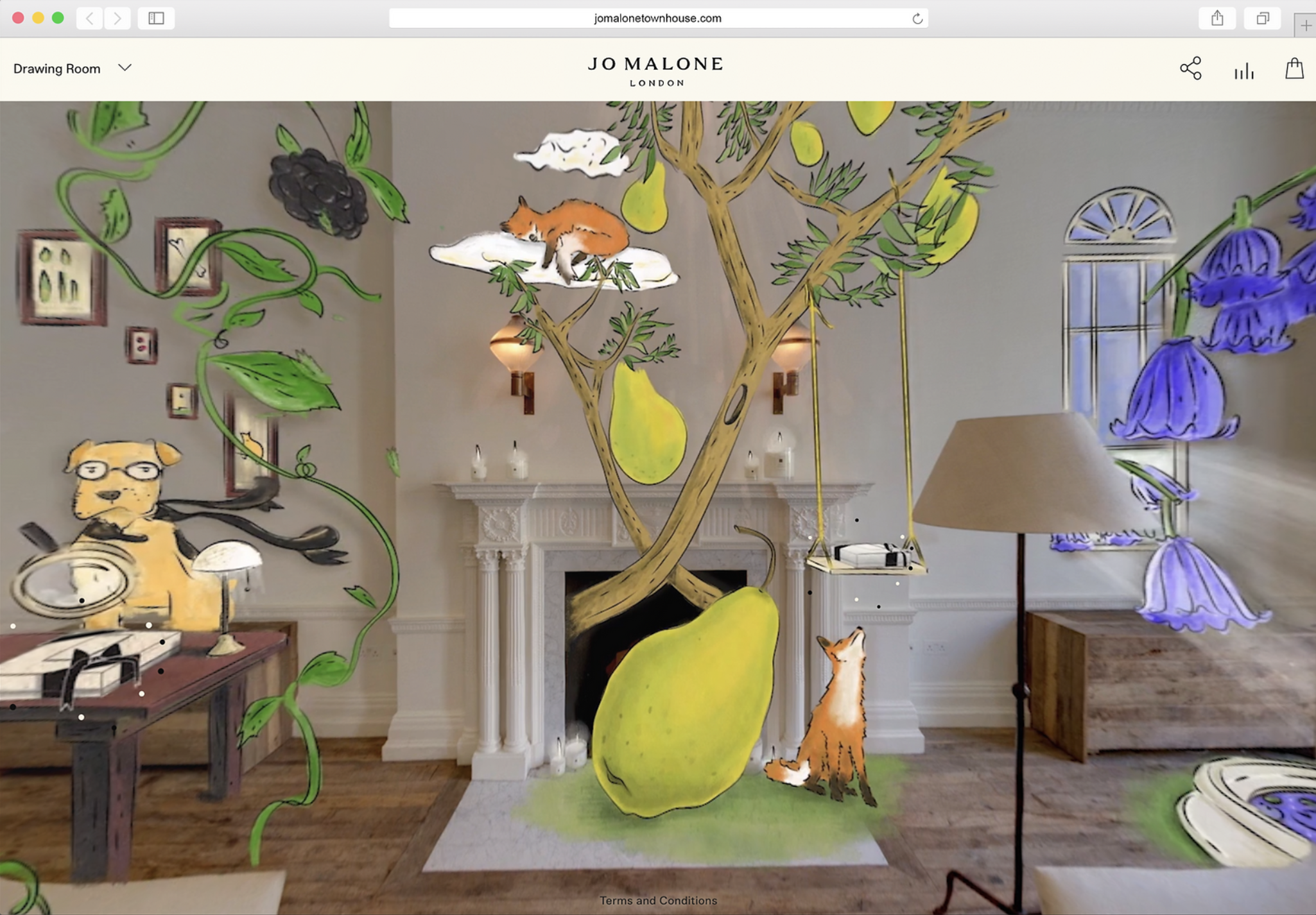
Users could discover Jo Malone’s well-loved collections through 360-based virtual worlds, each rendered in HD 360 video, and created through a combination of computer-generated graphics and whimsical hand-drawn illustrations.
Inside the Virtual Townhouse, users are invited to explore multiple virtual rooms where various surprises and playful multi-sensorial elements await.
The digital experience was a huge leap towards redefining the retail experience by inviting consumers to discover Jo Malone’s universe in a way that online e-commerce platforms or brick and mortar stores have never done before, and is available across Jo Malone’s key global markets, and can be explored through users’ own devices, anytime, and anywhere in the world.
Role: User Experience Designer
Harnessing facial tracking technology, augmented reality, and AI to aid in product discovery, recommendations, and application education, Burberry Beauty Virtual Studio is a hyper-personalised web-based experience.
01. SCAN / FACIAL TRACKING & ANALYSIS
Burberry Beauty Virtual Studio harnesses facial tracking technology to introduce a game-changing innovation within the experience. The face scan analyses and maps users' facial features to create their own unique and individual profile, which enables users to visualise and refine their results according to the look that they aim to achieve.
02. DISCOVER / MOBILE & WEB-READY VIRTUAL TRY-ON
Built on Holition's FACE™ technology, the virtual try-on and diagnostics tool tracks over 100 points of the face, designed to create hyper-realistic beauty looks.
With superior facial tracking and beautiful product visualisations, its virtual try-on functionality far exceeds other virtual cosmetics experiences by providing users with complete looks, without the need for a separate app.
03. LEARN / AUGMENTED REALITY GUIDED TUTORIALS
The experience also includes hyper-customised and AR-guided tutorials based on the individual's facial features (i.e. face shapes, eye shape, brows, mouth, and skin type), aiding in product education, whilst enabling users to get acquainted with characteristics such as texture and colour.
The AR-guided tutorials are a pioneering innovation for virtual beauty retail experiences, featuring 3D stylised animations superimposed on the user's face to highlight specific points of make-up application.
With 7 Beauty Glow looks to choose from, users can set their preference according to occasion and desired finish (e.g. day to night look).
Role: Mentor - Narrative Design
Visualising Life at the Tate
A multidisciplinary collaboration between the Tate and Holition, The Tate Ecosystem presents a microcosm of life at the Tate, both online and in the galleries.
The data visualisation was exhibited at the November edition of Tate Lates and is the output of Holition's annual Summer Internship Programme, which brought together students from all over the world to bring the project to life.
The Tate as a Living Organism
Inspired by diverse patterns and structures of natural ecosystems, two visual narratives were created to highlight the interactions within the Tate, one of the world's leading hub of international modern and contemporary art.
The first data visualisation focuses on the physical space of the Tate. Similar to the beautiful flow and movement of natural ecosystems, data was sourced to measure the movement of people within its six entry points. Each strand of the visualisation represented 10 people while the width of each cluster represented the flux of people entering the building over time.
The second visualisation harnessed online data to communicate the global engagement that the Tate attracts. Using an artistic narrative, a combination of flowers were used as the second metaphor. Each flower within the visualisation represented a month (1 petal = 1 day) of online activity within the Tate. The length of each petal was used to communicate the number of social media impressions received by the Tate per day, while the length of the leaves represented the total monthly social engagement. Finally, the amount of bulbs within each flower was also used to represent the social media reach of the Tate within a month.
Visual Metaphors
The data visualisations were featured in the November 2019 edition of Tate Lates, an evening of art, music, film, drop-in workshops and pop-up talks hosted by the Tate every month. The project explored visual language and the use of different metaphors to communicate a powerful story that is both relevant and beautiful.
Role: Lead Experience/UI Designer
Holition was commissioned by Jenny Holzer’s studio to design and consult on an augmented reality web app, with which the artist responds to the challenges of participation in the arts during a pandemic. The app allows users to project, in augmented reality, different texts from the university’s core cirriculum onto the architecturally significant buildings on campus— including works by distinguished writers W. E. B. du bois, helen keller, audre lorde, toni morrison, friedrich nietzsche, plato, mary shelley, and virginia woolf.
The app relies on gps to determine the users’ location, in order to activate the experience that is tied to the particular site they are near. Users are able to take a photo to share or save, as well as access the list of works included in the project.
Users also have another route available within the app, which allows them to project 29 different texts into the space around them, wherever they are in the world. The selected texts invite users to consider the impact of public speech in a democracy in the weeks and days leading up to the 2020 election.
Photography: © christopher dilts